
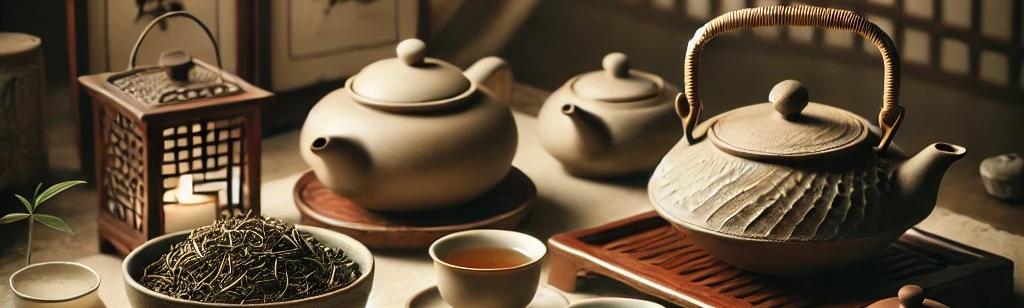
Tea Culture in China and Japan was an important ritual for social interaction, with many rules and observances to follow.

Tea Culture in China and Japan was an important ritual for social interaction, with many rules and observances to follow. The philosophy and practice was different for each country, but the basis was the same, to meet for the enjoyment of Tea with friends or guests.
Tea was first discovered and used as a herbal remedy in China, going back centuries to the early Han period (206 BCE – 220 CE). It was then developed as a herbal drink for special occasions and enjoyment in the Tang dynasty (618-907) and used by the emperor’s court and high officials. Delicate porcelain cups were used with a variety of added flavours, including ginger, ginseng, orange peel and onions.
Tea houses began to emerge in the wider society, providing meeting places for discussion on the arts and politics of the day, much like English Coffee houses and French Café culture. Buddhist monks developed green tealeaf shoots which were ground and found to be a stimulant in long hours of meditation.
In Japan the Tea Ceremony developed differently, becoming a tranquil exchange between host and guest in a private Tearoom, as opposed to a public Teahouse in China. The Tea Garden was the journey towards the Tea House, in preparation for the shared ritual to come.
Private estates often had their own Tea Houses, in separate areas to the main garden. Modern Tea Houses can be found almost anywhere, and have become a symbol for refined and experimental architecture among contemporary artists and designers.
How to book this event:
Members are free
Guests pay at the door
Suzanne Perrin
An independent researcher and historian specialising in Japanese History, Art & Culture, and founded Japan Interlink in 1995 to promote the understanding of Japan in the UK. Suzanne studied Nihonga traditional Japanese painting at Nagoya University of Arts and gained a certificate there, and reached Level 3 in Japanese Language at the Japan Foundation in London. Suzanne has lectured to a wide range of institutions including universities, museums and adult education groups in the UK and overseas. She taught Japanese History & Culture at Richmond American International University in London for over ten years, lectures for the Arts of Asia course at the Victoria & Albert Museum in London, for the British Museum and London Institute Universities, the University of Cape Town, and University of Brighton Art & Design School; has given lecture tours for DARTS in South Africa, ADFAS in Australia and for The Arts Societies in Europe (Spain, Germany, Malta, Belgium). Suzanne has organised exhibitions of Japanese arts and crafts including Kimono exhibitions for demonstration and display. Suzanne has published articles on Japanese culture and contemporary living for various magazines, and published her first book in 2016 titled: Bridges: Anglo-Japanese Cultural Pioneers 1945-2015. She is working on her second book on Japanese craftspeople in Kyoto, and visits Japan regularly to continue her research. She is now based in Sherborne Dorset.
GALLERY 
OTHER EVENTS

Society
Roger Askew
14 Oct 2026 - 20:00
Avenue Paul Hymans 2
Online Event
This lecture, illustrated with musical examples and video, will explore the marvellous work of this multifaceted composer.

Society
Simon Whitehouse
9 Dec 2026 - 20:00
Avenue Paul Hymans 2
Online Event
In this lecture we play armchair detective and follow trail of clues to discover more about the London life of the "Queen of Crime".