
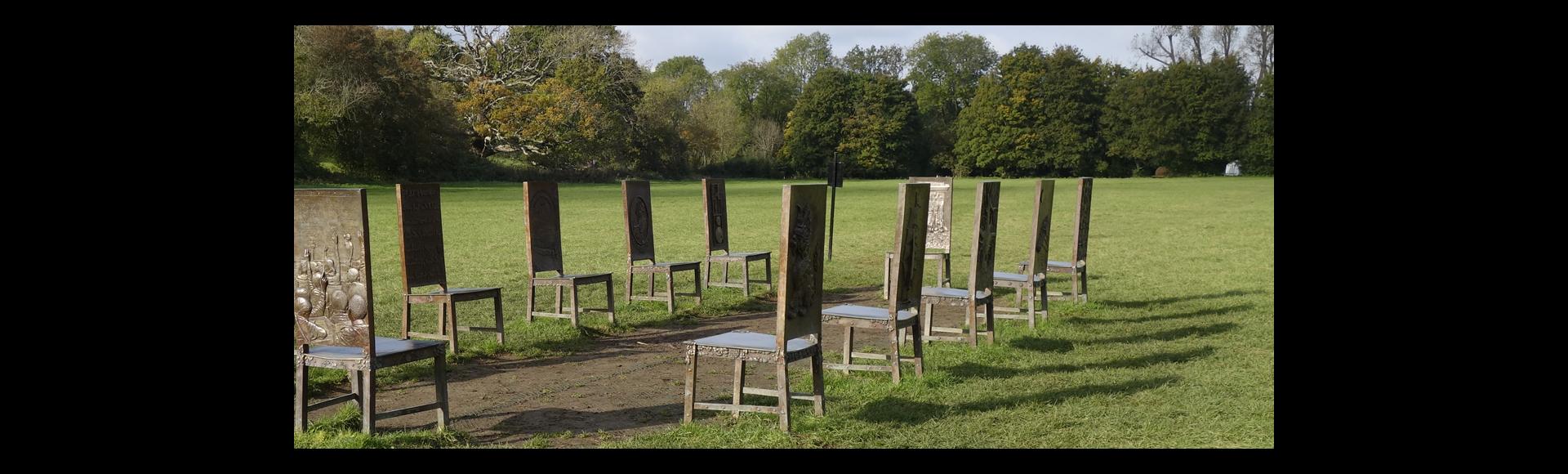
Barbara Hepworth tand Elisabeth Frink are two of the most popular British sculptors of the 20th century.

Barbara Hepworth took British and world sculpture to new levels of expressive lyrical abstraction. While we can look for meanings in them, her sculptures can be enjoyed and experienced simply for their look and feel. These days her sculptures have a timeless quality to them, which was a deliberate ploy as she sought to combine antiquity and mythology with the cutting-edge present. She also, early on, admired the Cubist and blockish Return to Order paintings of Picasso, and some of her figurative sculptures of the 1920s and 1930s reflected his influence.
Elisabeth Frink is probably one of the most popular British sculptors of the 20th century. The subjects for her work were usually birds, horses and men. Her sculptures of birds, and hybrid bird-human forms, reflected the human condition as she saw it. Her sculptures of horses reflected her life-long fondness for these graceful animals. But it’s her sculptures of men that are her most startling or revelatory. That’s because, she saw men as both heroes and villains, and her sculptures of fallen (male) angels, Greek warriors and a Dying King reflect this point of view. In doing so she was heavily influenced by wartime experiences and memories.
How to book this event:
Guests welcome. No need to book. First lecture free, thereafter £6 per lecture.
Raymond Warburton
Ray has had a life-long love of art. However, in his twenties, Ray studied social sciences at the London School of Economics and the School of Oriental and African Studies. These studies led to a career in health and social care, with art being an evening and weekend passion. But all that changed in 2011, when Ray became a guide at Tate Britain and Tate Modern. Then from 2014 to 2017, he studied art history at the Open University, and then at the University of Buckingham, from where he gained an MA in the History of Art. And to cap it all, Ray became an Arts Society lecturer in 2017. Ray also knows what it’s like to be on the receiving end of lectures as he is a member of his local Arts Society in Blackheath.
GALLERY 
OTHER EVENTS
Society
Harriet Riddell
16 Sep 2026 - 10:30
The Green, Wraysbury, Staines TW19 5NA
Online Event
Adventures around the World with a Sewing Machine

Society
Martin Lloyd
18 Nov 2026 - 10:15
Online Event
How we use it to fox the forger