In-venue in Winchester and online via Zoom
with Dr Kathy McLauchlan


In-venue in Winchester and online via Zoom
with Dr Kathy McLauchlan
Day 3 of the 2026 Jean Bolton Memorial Study Course
Art and Colour
Course Outline:
Colour has a profound impact on our perceptions, attention, experiences and emotions making it a powerful element in life and in the arts. This series of lectures seeks to explore the role and impact of colour in different periods of history and geographical locations as well as identifying the sources, composition and development of artistic materials. We will also explore the symbolism, meaning and spiritual significance of colour. Examples will demonstrate the power of colour to attract and focus attention, express and impact emotion, intensify experience, and communicate non-verbally. The series will also explore the varying status and importance of colour verses drawing and line and variations including: vibrant v. muted, oil pigments v. egg tempera, watercolour and fresco and the development of materials over the historical periods. In some sessions attention will also be given to the particular role of Venice as a supplier of pigments and source of important developments. Links between the concept of colour in visual, musical and auditory art forms will be made in some sessions. The 5 study days will cover the Medieval, Renaissance and Baroque periods in Western European Art together with the Nineteenth century in Western and Eastern European Art.
Day 3 with Dr Kathy McLauchlan is entitled: Innovations in Colour: European Painting and Sculpture, 1800-1900
Kathy will present 3 sessions as follows:
Session 1. Colour versus Line
Art academies traditionally saw art in hierarchical terms – according to subject-matter, function, materials and method. In theory at least, colour was deemed to be ‘inferior’ to line – its sensuality and materiality set against the intellectual rigour of line. In French academic teaching of the 19th century, drawing still took priority over painting. It was, as Ingres put, “the probity of art… the expression, the inner form, the composition, the modelling.” Line gave a composition its structural clarity and moral truth. Colour came a poor second, and at its worst might be a distraction. Ingres, together with other leading academicians, saw their traditional values as under threat from an alternative approach to art, one that emphasised spontaneity, expression and experience over abstract ideals. Delacroix in particular rejected precision in contours and finish, but used vibrant, contrasting colours and a richly textured surface to communicate effects and feelings, and create “a bridge between the soul of the artist and that of the spectator.” The line/colour debate associated with Ingres and Delacroix grew into one of the recurring themes of 19th-century French art.
Session 2. The Colour of Sculpture
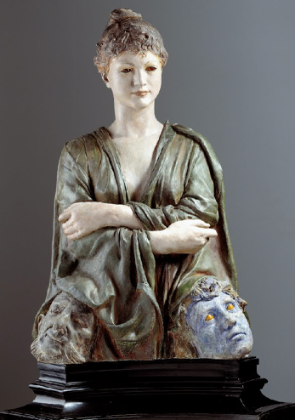
Archaeologists and historians of the 18th century were increasingly aware that classical sculptors made use of colour. Their claims cut against an ideal of pure, harmonious form traditionally associated with the white marbles of antiquity. But the evidence was clear, and growing numbers of modern sculptors responded by carrying out their own experiments with colour. Canova sought to impart a more lifelike appearance to his work by applying wax finishes and touches of pink and gold. Later artists were less subtle, determined to regenerate their art and free themselves from traditional associations between sculpture and whiteness – “white poems of marble…the despair of modern art.” (Gautier, 1855) Late 19thcentury sculptures might combine a wide range of material: semi-precious stones, applied pigments, enamels, ivory, bronze and marbles. Degas’s Little Dancer of 1881can be linked with this movement. Other sculptors were less interested in naturalism than in symbolic meaning. Some of their work - notably that of German artist Max Klinger – has an extraordinary and disturbing power.
Session 3. Symphonies in Colour
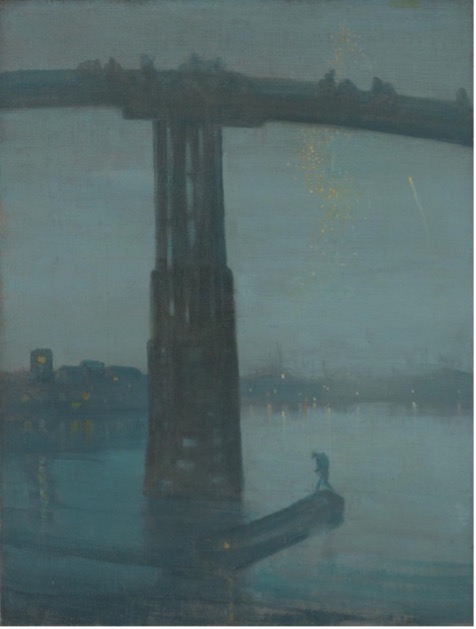
In the late nineteenth century, many western artists turned away from using colour to represent the appearances of objects and motifs in nature. Instead, they saw colour as means towards visual harmony in art. Aesthetic values took precedence over realism, with critics and artists alike drawing analogies between colour relationships on a painted surface and musical composition, rhythm and melody. This idea dominated the work of artists associated with Aestheticism, above all the American painter James McNeill Whistler who gave musical titles to many of his works: notably Symphony in White, No. 1: The White Girl and Nocturne in Blue and Gold – Old Battersea Bridge. Such works called on their viewers to concentrate on the subtle arrangement and gradation of colour over all other considerations. For Whistler, the subject as such was extraneous to a painting’s true purpose – its value as a beautiful object, and its potential to express the subtlest nuances of atmosphere and mood.
You can book for the whole course or just individual days. The course consists of 5 days as follows and all are available in venue (Winchester) and online via Zoom:
Price: £35 per day in venue, to include coffee/tea, light lunch with wine or soft drinks; £15 per session for online attendees.
This year we are offering a reduced total fee of £165 and £70 for in-venue and online tickets respectively when you select all 5 days as a bundle. Please see the Ticket Tailor box office for further details.
For more information go to: https://theartssocietyhantsiowarea.org.uk/Special/Special.aspx
Tickets: https://buytickets.at/theartssocietyhampshireandisleofwightarea
Contact the organiser if required at: hampshireisleofwightarea@theartssociety.org
A lecturer specialising in 19th-century art history, I am currently a course director at the Victoria & Albert Museum, organising courses and study days on the history of art and design. I teach at several institutions, including Art Pursuits. I am a graduate of Oxford University and the Courtauld Institute, with a PhD on French 19th-century painters in Rome. I am available for both individual lectures and study days. In addition to the subjects on my page I can cover:
• Sketch and Finish in 19th-century French Painting
• Montmartre fin de siècle
• Mucha and the Slav Epic
• America and the Sublime Landscape