

There are just a very few tickets left for our Special Interest Day 'Radicals and Rivals' on Friday 27th November.
Newsletter January 2026
Newsletter January 2026
Our December local lecturer, Olaf Winkler, journalist, architecture critic, guide and artist, introduced his lecture with a presentation of the book Bruxelles Art Deco by Cecile Dubois, which gives seven walks which you can do on foot or by bike to discover the many different aspects of Art Deco and modernist architecture in various neighbourhoods throughout Brussels.
Art Deco, which was essentially an extension of the decorative Art Nouveau, developed in the Twenties, became the epitome of luxury and refinement. The Belgian architect Alphonse Hubert Francis Balat, born in 1818, settled in Brussels in 1846 and was appointed as the architect of the Duke of Brabant, the later King Leopold II. In 1856, he constructed the town palace (Hotel) of the Marquess of Assche (Asse) in the newly planned district called the Leopold Quarter. It was noticed for its austere classical neo-Renaissance facade inspired by Michelangelo's Palazzo Farnese in Rome. Balat's most successful architectural project is the Royal Greenhouses of Laeken. It consists of a huge complex of several dome-shaped buildings, in iron and glass, connected by glass-roofed galleries. The centrepiece is the domed Winter Garden. In the steel constructions, he introduced decorative motifs derived from plants and flowers. This formed a first step towards Art Nouveau architecture that was further developed by Victor Horta, who served as an apprentice of Balat.
Michel Polak designed the villa of Baron Louis Empain. The "Villa Empain" is now the Boghossian Foundation, which has chosen a universal language - that of artistic expression - to promote dialogue between cultures.
The brewery Wielemans Ceuppens was built in 1931 by Adrien Blomme for the Wielemans-Ceupens family, classified building and its contents in 1993, and is now a contemporary art centre, which opened its doors in 2016 and was named "Wiels".
Note: Richard Hollis' book: Artist as Designer.
Henry Clemens van de Velde, born in Antwerp in 1863-1957, was a Belgian painter, architect, interior designer, and art theorist renowned as a "bridge between nineteenth-century eclecticism and the emergence of a modern style", bridging the centuries. Together with Victor Horta and Paul Hankar, he is considered one of the founders of Art Nouveau in Belgium. He became a member of the Brussels-based artist group "Les XX". After Vincent van Gogh exhibited some work at the yearly exhibition of Les XX, Van de Velde became one of the first artists to be influenced by the Dutch painter. Look up "Winter Sun" 1892 created by H. van de Velde in the Neo-Impressionism style. Angels' Vigil, a tapestry by Van de Velde, is a transition within artistic disciplines.
Cultural Reflections: The Great War ended in 1918, and Wall Street was in panic as stocks crashed in 1929. Overcoming the scarcity of residential space gave birth to the Cité Moderne, which is a modernist housing complex designed by architect Victor Bourgeois, and urbanist Louis Van der Swaelmen in Berchem-Sainte-Agathe. The garden city movement, nurtured at the beginning of the 20th century, brought a tranquil rustic character to Brussels communes and addressed questions about social housing.
The Residence Palace, built by Swiss architect Michel Polak, is a stunning apartment building with a sky-blue mosaic fountain in the entrance hall. It was built for the bourgeoisie. The building's life as a housing complex was short-lived and now houses the International Press Centre for EU media.

MORE FEATURES
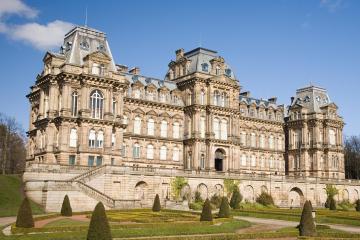
The distinguished Honorary Vice-President of the Arts Society North Yorkshire and South Durham, Elizabeth Conran, ste
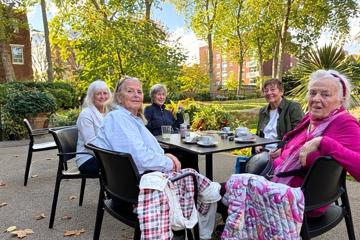
Our lovely group of members and guests had a relaxed and informative visit to these two artists’ homes.